







Overnight, Israel and the United States launched a coordinated opening wave against Iran under Israel’s Operation Roaring Lion, while U.S. Central Command said it began Operation Epic Fury at the president’s direction, striking IRGC command-and-control sites, air defenses, missile and drone launch infrastructure, and military airfields. The stated aim from Jerusalem is to roll back what Israel describes as an existential threat trajectory tied to Iran’s nuclear reconstruction push, missile stockpiles, and regional terror machinery.
Iran’s response came fast and wide. In Israel, at least one Iranian missile strike hit central Tel Aviv, killing a woman and injuring others, with emergency services reporting multiple additional casualties. Israel imposed emergency nationwide restrictions, including shutting schools, limiting workplaces and gatherings, and directing civilians to stay close to protected spaces as further barrages were anticipated. Israeli airspace was also closed, disrupting inbound and outbound civilian aviation as airlines diverted aircraft and suspended schedules.
Stay informed with JBN email alerts! Get the latest updates on breaking stories, global events, and community news directly in your inbox.
The conflict did not stay confined to Israel–Iran. Reuters reported Iranian missiles were fired toward multiple Gulf cities and states hosting U.S. forces, with governments in Kuwait, Qatar, the UAE, and Bahrain saying interceptions took place; Jordan also reported intercepts. CENTCOM said its forces helped defend against “hundreds” of Iranian missile and drone attacks, adding it had no reports of U.S. casualties and only minimal damage to U.S. installations.
One of the most consequential ripple effects is at sea. Reuters cited an EU naval mission official saying IRGC forces broadcast warnings that no ships were allowed to pass the Strait of Hormuz, even as Iran did not formally confirm a full closure. Reuters also reported energy and shipping companies suspending or rerouting traffic through Hormuz amid escalating risk, with wider market anxiety centered on the chokepoint that underpins a major share of global oil and LNG flows.
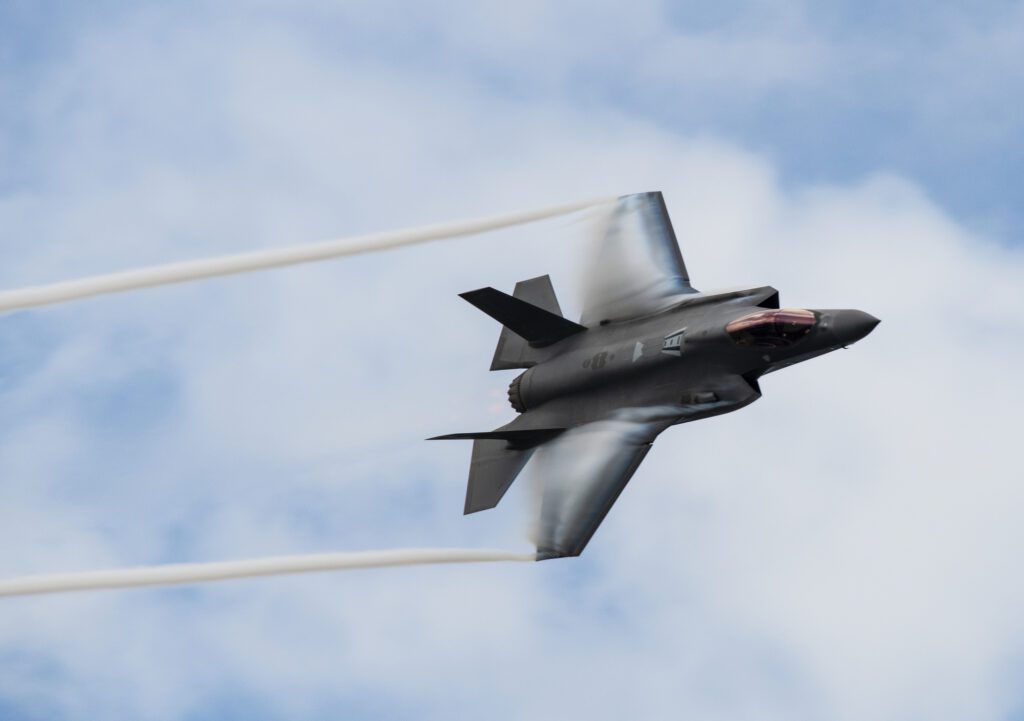
Advanced USAF stealth fighter.
Captured on March 31, 2019.
Location is the Melbourne Air and Space Show, Melbourne, Florida.
Politically, the world rushed into damage control and blame assignment. At an emergency U.N. Security Council meeting, the U.N. chief condemned the U.S.–Israeli strikes and warned about regional spillover, while the U.S. and Israel defended the operation as necessary to prevent an Iranian nuclear weapons outcome; Iran’s envoy denounced the strikes and cited civilian casualties. Meanwhile, President Trump publicly claimed Iran’s Supreme Leader Ali Khamenei was killed; Iran has not confirmed that claim, and reporting has varied on what is verified versus asserted.
Israel is also signaling that the battlefield is not only missiles and jets. A notice carried by Israeli outlets quoting the Prime Minister’s Office said Israel’s National Security Council warned Israelis abroad to heighten precautions, citing increased risk of attempted attacks targeting Israelis and Jews worldwide by Iran and other terror actors in the immediate timeframe.
What happens next hinges on whether Iran can sustain meaningful launch capacity under continued strikes on launchers and air defenses, and whether Tehran broadens the fight through proxies or maritime escalation. Israel’s posture suggests this is not a one-night exchange but the start of a sustained campaign; CENTCOM’s language also frames the operation as an ongoing effort to dismantle imminent threats.


Above: Rocket impacts across central Israel.
Stay informed with the latest Jewish news, real-time Jewish breaking news, and in-depth Israel news coverage from our newsroom. For continuing updates, expert perspectives, and trusted reporting, visit our main news hub here.
Israel and the Middle East – Jewish Politics – Jewish Culture and Lifestyle – Videos – Jewish World










Comments (0)